
Is a confined space rescue tripod what you really need?
Before explaining the reason behind the title of this article—which might make you think I’m speaking without knowing what I’m talking about, or that I’m trying to downplay the role of the confined space rescue tripod, or even suggest that it has no real use—let me first clarify that this is not the case.
I’d like to welcome you back and thank you in advance for taking the time to read this article. My goal is simply to share information that adds to your safety knowledge and helps you better understand how this equipment truly fits into confined space rescue scenarios.

Let’s start by clearing up any misunderstandings. The purpose of this title is not to diminish the role of the confined space rescue tripod in any way. On the contrary, a tripod is a very important and necessary tool when working in certain confined spaces—and that word is key. The tripod does not solve every situation, and in many cases, it simply does not fit the conditions you are dealing with because it also has practical limitations.
Before going into detail about the functions of a confined space rescue tripod, it’s important to make one thing clear: using a tripod is not mandatory when working in confined spaces. What is mandatory is having a rescue system that adapts to the actual conditions of the confined space you are entering.
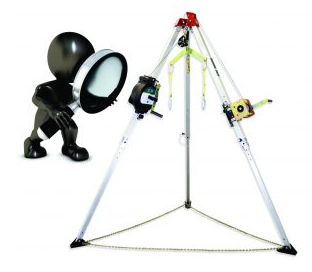
It’s also important to understand that the tripod is not the only device that can be used as part of a confined space rescue system. There are many alternatives with different designs, shapes, and configurations—some of them extremely sophisticated. But before discussing why an alternative to the tripod may be necessary, let’s first take a closer look at the tripod itself, the components it typically includes, and the conditions where it truly fits. From there, you’ll be able to draw your own conclusions about its proper use and its limitations.
NOTE: The description of the confined space rescue tripod in the following sections refers to the simple, most commonly used tripods in the industry. Some manufacturers add additional features beyond these basic characteristics, providing users with more options for different applications.
Typical confined space rescue tripod
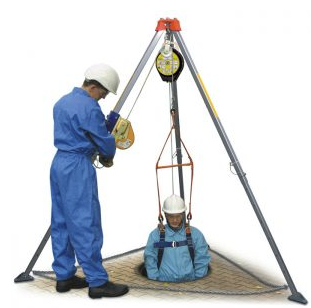
As the name suggests, a tripod is a three-legged structure used as a support component within a victim retrieval system in the event of an accident inside a confined space.
It is positioned at the entrance of a confined space that has a vertical top entry, such as manholes, silos, tanks, or underground water cisterns.
This device is limited to vertical entry applications and is intended for use by no more than one person at a time. A victim retrieval system is attached to the tripod, which may consist of a rope system, a manual winch, or an electric winch. It must also include a backup system, which is mandatory in any personnel suspension system.
NOTE: The most commonly used retrieval device is the manual winch. Electric winches have limitations, such as the inability to be used in flammable atmospheres, since the electric motor could create an ignition source. Another limitation is the need for a power supply, which is often not readily available and may require long electrical extensions. Always remember that before selecting any equipment for high-risk work, the area must be inspected in advance to determine which system best fits the conditions you will face.
Keep in mind that this description refers to a basic, commonly used tripod with a simple design. Some manufacturers offer models with additional features, and some can even be configured for use by more than one person at a time.
With that in mind, let’s review the typical components found on a standard tripod, aside from the retrieval device itself.
A typical confined space rescue tripod usually includes the following components:
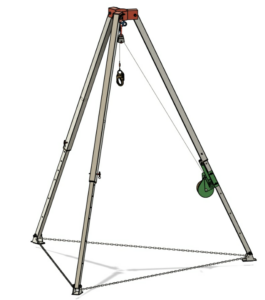
- Non-slip feet
- One mounting bracket for multiple devices, adaptable to any leg
- One manual or electric winch
- Leg restraint chain
- One pulley
- Multi-anchor plate
- Three quick-assembly locking pins
- Adjustable telescopic legs
- Maximum height: 8 ft (2.40 m)
Based on what you’ve read so far, you can probably already see the limitations of a confined space rescue tripod. While it is a very useful tool, it only works in confined spaces with very specific characteristics. It is not suitable for spaces that do not meet the configuration required for its use.
Let me give you some examples of common industrial confined spaces where a tripod cannot be used as the retrieval support.
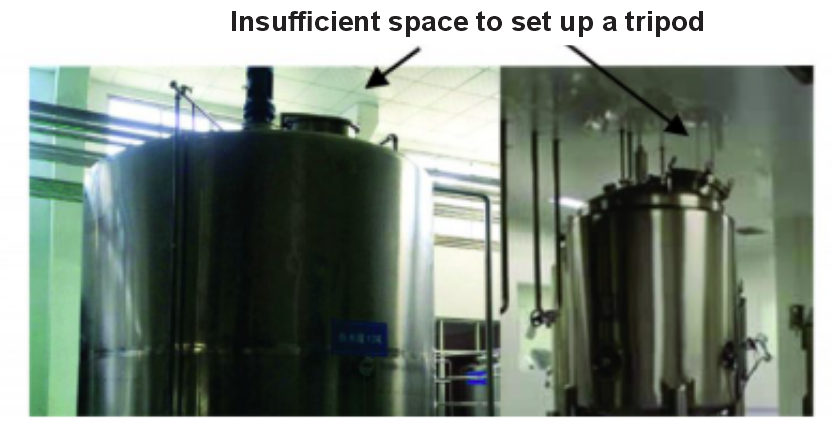
- A confined space where the top entry is too close to a structure or ceiling, preventing the tripod from being properly set up due to lack of clearance.
- A confined space where the entry point is lateral instead of vertical.
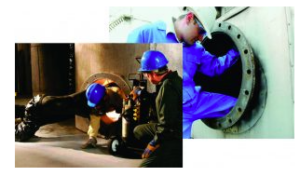
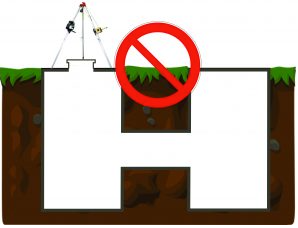
- A confined space with an internal configuration made up of multiple chambers, rather than a single open area.
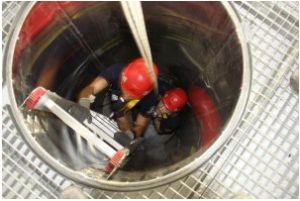
- A confined space where more than one person must work inside at the same time.
The examples above are just a few that came to mind while writing this article. If you are familiar with how rescue tripods are actually used in confined spaces, you can likely think of many more scenarios where a tripod simply does not fit.
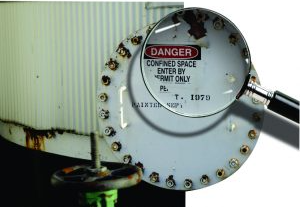
This is why equipment selection in confined space work must be done carefully. You may be planning to use a rescue tripod that does not match the actual conditions you will face. Remember, using a tripod is not mandatory when working in confined spaces. What is mandatory is having a rescue system that adapts to the specific configuration of the space and to the number of workers inside.
Do not overlook this. Not having the right rescue system in place can cost lives if an accident occurs.
In the next section, to clarify what is meant by “a rescue system that adapts to your needs,” we first need to differentiate the types of rescue methods used in confined spaces, since the way a rescue is performed depends on the conditions both inside and outside the space.
Confined Space Rescue Methods:
Rescue without entering the confined space
This should always be considered the first option, whenever possible, because it does not place any additional person at risk during the rescue. The victim is retrieved from outside the confined space, requiring only proper knowledge of how to use the recovery equipment described below.
This type of rescue is applicable when the confined space has a simple internal configuration—a single open area without multiple chambers, internal passages, or ductwork (for example, an empty water cistern that consists of one open compartment).
The rescue is performed using external retrieval systems, such as rope and pulley systems or steel cable systems like manual or electric winches. These retrieval systems can be attached to nearby fixed structures such as beams, columns, anchor points, or even a vehicle, as well as to portable structures specifically designed for this purpose, such as rescue tripods, gantries, portable davit arms, or structures designed for lateral entries.
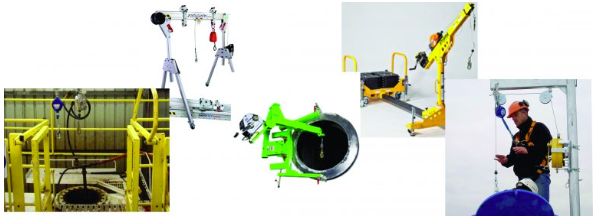
Stepping slightly aside just to reinforce the point of this article, it’s worth mentioning that each manufacturer designs its own retrieval devices—some more complex than others. Many of them perform similar functions and share the same limitations as a tripod, even though they do not have the tripod’s three-leg configuration.
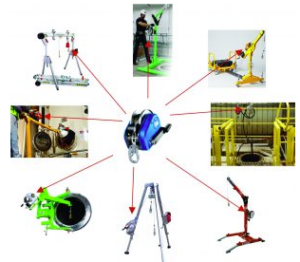
As you can see, tripods, davit arms, anchor points, columns, beams, or any nearby structure are not the actual rescue or victim retrieval systems. They are simply support structures where the real retrieval system is installed. The type of support you use to set up your confined space retrieval system depends entirely on the conditions you encounter both inside and outside the space. Remember, the requirement is to have a rescue system that adapts to your needs.
As a last resort—and only if the situation truly leaves no alternative—a worker could enter the confined space wearing a full-body harness connected to a rope, so that in case of an accident, others could pull them out.
NOTE: This rope example is intentionally exaggerated to make a point. Proper confined space retrieval systems not only allow rescue without requiring another person to enter, but also provide mechanical advantage to reduce the load during the recovery.
Rescue with entry into the confined space
This rescue method is used when it is not possible to perform a retrieval using external systems like the ones described earlier. This typically occurs in confined spaces with multiple chambers, internal ducts, or structural elements that could trap the victim or interfere with the retrieval line.
To better understand this, consider the following example:
Imagine you are working in a confined space made up of two chambers connected by a duct or passage. If an external retrieval system such as a tripod were used, the rope or cable could be damaged by sharp edges inside the space. The victim could also become snagged or injured against those edges. Additionally, if the connecting passage is elevated, attempting to pull the victim out could create a pendulum effect during the retrieval.

Situations like this are not uncommon. In many cases, an external retrieval system alone is not enough to safely rescue a victim. This is when specially trained confined space rescue personnel are required to enter the space, reach the victim, and move them to a location where the external retrieval system can function properly.
These specialized rescuers are trained not only in the use of confined space entry equipment—such as self-contained breathing apparatus (SCBA), supplied air lines, and atmospheric monitoring devices—but also in the use of full rescue equipment, including ropes, pulleys, stretchers, descent devices, immobilization equipment, and comprehensive first aid.
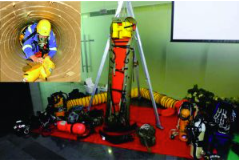
As you can imagine, becoming part of a confined space rescue team requires extensive training. Rescuers must learn not only how to properly use the complete rescue system, but also how to operate while wearing confined space entry equipment that significantly restricts movement. These training programs often last several days and place candidates in realistic scenarios that must be resolved within a set time in order to obtain certification.
Having a trained rescuer or a dedicated rescue team available is also considered a valid way of meeting the requirement to have an appropriate rescue capability for the specific conditions of the confined space.
NOTE: As you can see, everything discussed in this article reinforces the importance of performing a proper Job Safety Analysis (JSA) before starting work. This allows you to determine the rescue method and equipment that best match the conditions you will face. The JSA is a critical document that should be completed daily before starting work, but I will not go into detail here since that is not the focus of this article. I cover it thoroughly in another article in our virtual library, which you can review at the following link:
As you’ve seen, a confined space rescue tripod is not the only option for supporting a victim retrieval system. There are many alternatives that can be purchased or improvised—the key is choosing a solution that truly fits your specific conditions and needs.
I hope this article has been useful. I felt it was important to write it because confined space rescue is often misunderstood, with many believing that a tripod is always mandatory. As you’ve seen, when conditions are not suitable for its use, relying on one can actually put a member of your team at risk if an accident occurs.
I’ll close by, as always, thanking you for the time invested in reading this article. I hope you found it valuable.
Have a safe day.
Until next time.
Author: Gianfranco Binda
Bison Up – High Access Specialist