
Is it difficult to choose the equipment that will actually protect you?
Very often, when working at height, it can feel overwhelming to decide which equipment should be used to build a proper personal fall protection system.

NOTE: A personal fall protection system consists of at least three elements: Harness, Connector, and Anchorage Point.
This article will not go into detail about how a personal fall protection system is structured, as that is not its purpose. This topic is covered more thoroughly in another article. For now, let’s stay focused on the subject at hand: as mentioned earlier, selecting the right equipment is not always simple.
However, if we consider that fall protection equipment must always comply with recognized standards, we can remember that both harnesses and connectors are manufactured by specialized companies that ensure these components meet all regulatory requirements, including their minimum strength ratings.
With that in mind, within the configuration of a personal fall protection system, the element that can often be considered the “weak link” is the anchorage point. This is because, in many cases, it is not an element originally designed for fall protection.
Even when anchorage devices are specifically manufactured for this purpose (such as branded anchorage points from fall protection equipment manufacturers), they can still fail if they are not installed correctly.
The following guidelines outline the key criteria you should respect before choosing the element you will connect to and trust with your life.
What Is an Anchorage Point?

There are many highly technical definitions of anchorage points available, but keeping it simple is far more useful for practical understanding.
In straightforward terms, an anchorage point for work at height is any element you can connect to that is capable of supporting at least 5,000 pounds (2,268 kg).
With that in mind, anchorage points can be grouped into four main categories:
1. Improvised Anchorage Points
Any structure capable of supporting at least 5,000 pounds (2,268 kg) where a connector can be safely attached.
Examples include the steel angles used in many towers, the rosettes of certified scaffolding systems, fixed ladder rungs, and similar structural elements.
Before considering any structure as an anchorage point, its load-bearing capacity must always be verified.
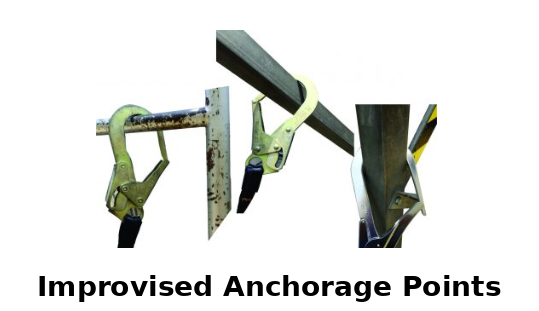
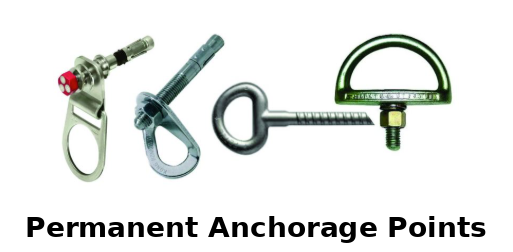
2.Manufactured or Branded Anchorage Points — PERMANENT
Anchorage points manufactured by specialized companies in accordance with regulatory requirements. These anchorage devices are installed using bolts, welding, or chemical anchors and are intended exclusively for fall protection use.
They remain permanently attached to the structure where they are installed and must be placed on structures capable of supporting at least 5,000 pounds (2,268 kg).
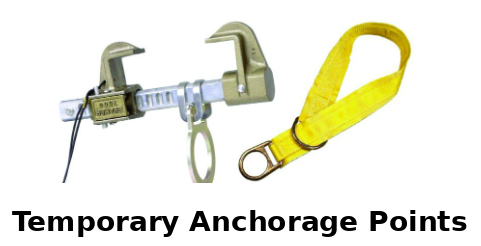
3.Manufactured or Branded Anchorage Points — TEMPORARY
Elements manufactured by specialized companies in accordance with regulatory requirements. Unlike the previous type, these anchorage devices do not remain permanently attached to the structure.
They are installed only for the duration of the work at height and removed once the job is completed. Examples include anchorage straps (chokers), beam anchors, and similar devices.
They must always be installed on structures capable of supporting at least 5,000 pounds (2,268 kg).
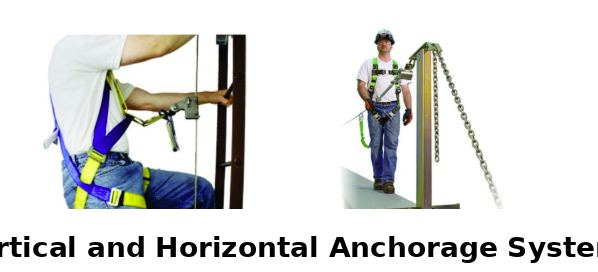
4.Anchorage Systems
As the name suggests, these consist of multiple elements working together to create an anchorage. Examples include vertical anchorage systems (a combination of elements arranged in a vertical configuration) and horizontal anchorage systems (a combination of elements arranged in a horizontal configuration).
These systems must be installed on structures capable of supporting at least 5,000 pounds (2,268 kg).
NOTE: As you can see, the common characteristic shared by all these elements is their minimum strength rating of 5,000 pounds (2,268 kg).
Installation of Anchorage Points
When it comes to improvised anchorage points and manufactured or branded — temporary anchorage points, installation is generally straightforward. You simply connect the hook of your connector to the structure or place the temporary anchor after verifying the structure’s load-bearing capacity.

Note: Whenever possible, position the anchorage point above shoulder level and in a way that helps prevent a pendulum effect in the event of a fall.
When installing an anchorage point, it is essential to consider the before, during, and after stages involved in the installation process.
Let’s talk about the installation of manufactured or branded — PERMANENT anchorage points.

Before continuing, it is important to clarify that installing permanent anchorage points requires proper training in installation and testing procedures. Reading this article does not qualify anyone to install anchorage points.
The purpose here is to help you understand what you should know before choosing where to anchor yourself, and to recognize the considerations a qualified installer takes into account during the installation process.
When installing an anchorage point, it is essential to consider the before, during, and after stages involved in the installation process.
1.Before installing a permanent anchorage point
As mentioned earlier, the primary criterion most installers consider when selecting the type or brand of anchorage point is that it must support at least 5,000 pounds (2,268 kg).

While this is the main requirement, it is not the only one. An anchorage device may be manufactured to withstand 5,000 pounds, but it will be ineffective if the surface or structure where it is installed does not meet the same strength criteria.
In other words, it is not enough for the anchorage point itself to meet the required strength rating. The installer must also evaluate the material and location where it will be installed. For example, it is important to consider whether the anchor will be secured by welding, bolting, or chemical anchors. In the case of chemical anchors, the ambient temperature must not exceed the product’s maximum degradation temperature, among other factors.
2.During the installation of a permanent anchorage point
Once the installer has determined the type of anchorage and where it will be installed, there are important considerations that must be respected during the installation process.
For example, if the anchor is installed by welding, material compatibility is essential. If the anchorage point is made of stainless steel, the welding material must also be stainless steel. It is equally important that this work be performed by a person properly trained in welding.
If the anchor is installed in concrete (never in brick or similar materials) using expansion bolts or chemical anchors, the installer must consider the distance between anchorage points and the edges of the structure where it will be placed (not less than 8 inches (20 cm)) to ensure proper strength and load resistance. Additionally, the hole where the bolt will be placed must be thoroughly cleaned, as residual concrete particles from the drilling process can compromise the effectiveness of the installation.

3.After the installation of a permanent anchorage point
Once the installer has completed the installation of the anchorage point, its strength must be confirmed to ensure it has been properly installed and is capable of performing its function.
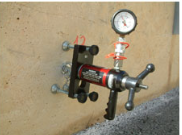
According to OSHA requirements, an anchorage point used for a Personal Fall Arrest System must be capable of supporting at least 5,000 pounds (2,268 kg) per attached worker, or it must be part of a system designed, installed, and certified by a qualified person with a safety factor of at least two.
It is important to understand that OSHA does not establish a single mandatory method for testing every installed anchorage point with a specific pulling force such as 3,600 pounds for a set amount of time. That requirement applies to certain components of the fall protection equipment, such as D-rings and snaphooks, but not to the structural anchorage point itself.
For permanent anchorage points, what OSHA requires is that they be identified, evaluated, and certified by a qualified person as capable of supporting the required load. This certification may be achieved through different accepted methods within the industry, such as structural analysis, engineering calculations, manufacturer specifications, or controlled load testing procedures.
In many professional practices, installers use pull-testing equipment as part of their verification process. However, this is considered a verification method based on industry best practices and engineering judgment, rather than a strict OSHA-mandated procedure with a fixed load and time.
Once this verification is completed, the installer should label the anchorage point with relevant information such as the date of installation or verification, applicable standard, identification code if required, and any inspection schedule that applies.
This final step provides assurance that the anchorage point was installed following proper criteria and evaluated by a qualified person, which is ultimately what guarantees its reliability in the event of a fall.
Conclusion
The purpose of this article has been to highlight the most important aspects of the selection, installation, and use of anchorage points. This is not intended to teach you how to install anchorage points (proper training is required for that), but rather to help you recognize the characteristics an anchorage point must have when you encounter one, and to verify that it was installed by a qualified person.
As you may have noticed, we did not go into detail about vertical and horizontal anchorage systems. There is a wide variety of these systems, and their configuration and installation are beyond the scope of this article. That topic will be addressed separately.
Work safely, and until next time.
Author: Gianfranco Binda
Bison Up – High Access Specialist