
Key Points to Know When Implementing an Effective Fall Protection Plan
 Implementing an adequate fall protection plan is often difficult. In this article, I want to outline some basic concepts to give you a solid foundation for building a suitable fall protection plan. Please note that these are concepts you can use to reinforce your knowledge and are intended to be complemented by in-person training on working at heights.
Having read the above, I hope you enjoy and use the following concepts appropriately:
It’s Not Just a Number — When Does Work at Height Actually Begin?
The legal requirement for fall protection is generally based on a specific height at which work is classified as “work at height.” This value can vary depending on company policies, industry standards, or the country where the work is performed.
For example, in the United States, the Occupational Safety and Health Administration (OSHA) establishes common reference thresholds of 6 feet (1.82 m) for construction and 4 feet (1.21 m) for general industry.

Regardless of the regulatory height that applies in your environment, it is essential to consider your personal safety as well. Fall protection should not be viewed only as a regulatory requirement. You should protect yourself not just because the law requires it, but because a fall from height can cause serious injury or even cost you your life.
It is helpful to look at this from a simple perspective of how the human body is designed (without getting overly technical).
The human body is naturally designed to function at ground level. Even small height differences —such as 4, 8, or 12 inches (10, 20, or 30 cm)— can represent a risk, because our bodies are not built to absorb impacts from elevated positions.
For example, when a person trips and falls forward at ground level, they can usually use their arms and upper body strength to absorb the impact. The body’s structure, muscle strength, and bone density are adapted to withstand these types of low-level falls.
 Now imagine standing on a chair 12 inches (30 cm) above the ground and intentionally falling forward to catch yourself with your arms. Even when you are prepared for the fall, the force generated is significantly greater and much harder for the body to absorb.
If that same fall happens unexpectedly, without being prepared, you may land with only one arm or without using your hands at all. As you can see —and easily picture with this simple example— what seemed like an insignificant height can result in injury.
The central point is that, even though regulations define a specific height at which fall protection becomes mandatory, the human body is not designed to work safely at any elevation above ground level. This reality should always be considered when developing a fall protection plan.m any elevation above ground level. This reality should always be considered when developing a fall protection plan.
From Lower Risk to Higher Risk — The Hierarchy of Fall Protection
Once you recognize that your task exposes you to potential injury in the event of a fall, the next step is to determine what type of fall protection best fits your needs, since not all equipment is suitable for every situation.
For example, as discussed in another article in our news section, a standard 6-foot (1.8 m) shock-absorbing lanyard does not provide adequate protection when working at heights below approximately 17.4 feet (5.3 m). In those cases, alternative solutions must be used to ensure proper protection at lower elevations.
Now, let’s talk about hierarchy. Over time, professionals working at height have relied on a fundamental concept known as the Hierarchy of Fall Protection. This approach prioritizes the use of simpler, more reliable protective measures first, and only progresses to more complex systems when conditions require it.
By “simpler,” we mean protective measures that involve minimal or no possibility of human error during use. More complex systems are introduced only when the nature of the task makes simpler solutions insufficient. In some cases, when the risk cannot be adequately controlled with common fall protection equipment, the final step involves the use of specialized equipment operated by certified professionals—such as work that requires a trained rope access technician.
Do Not Use Fall Protection Equipment — Use Fall Protection Systems
This title may seem misleading at first, as if it were promoting the idea of not using fall protection. That is not the intention. The title is intentionally incomplete to draw attention. The full message should read: “Do not use fall protection equipment, use fall protection systems.”
Before explaining the minimum components required in a fall protection system, it is important to understand the difference between equipment and a system.
Equipment is a single, individual element. A system, on the other hand, is a combination of elements working together to perform a specific function. If any part of the system is missing, the system cannot perform its intended function.
For example, a computer operates as an integrated system made up of multiple components working together to make the “miracle” of computing possible. If you remove any one component, the computer will no longer function properly because the complete system is no longer present.
The same principle applies to fall protection. A fall protection system is the combination of protective elements that work together to protect a user in the event of a fall. If any part of the system is missing, the user is not fully protected.
At a minimum (and sometimes more, depending on the task), a personal fall protection system for work at height must include:
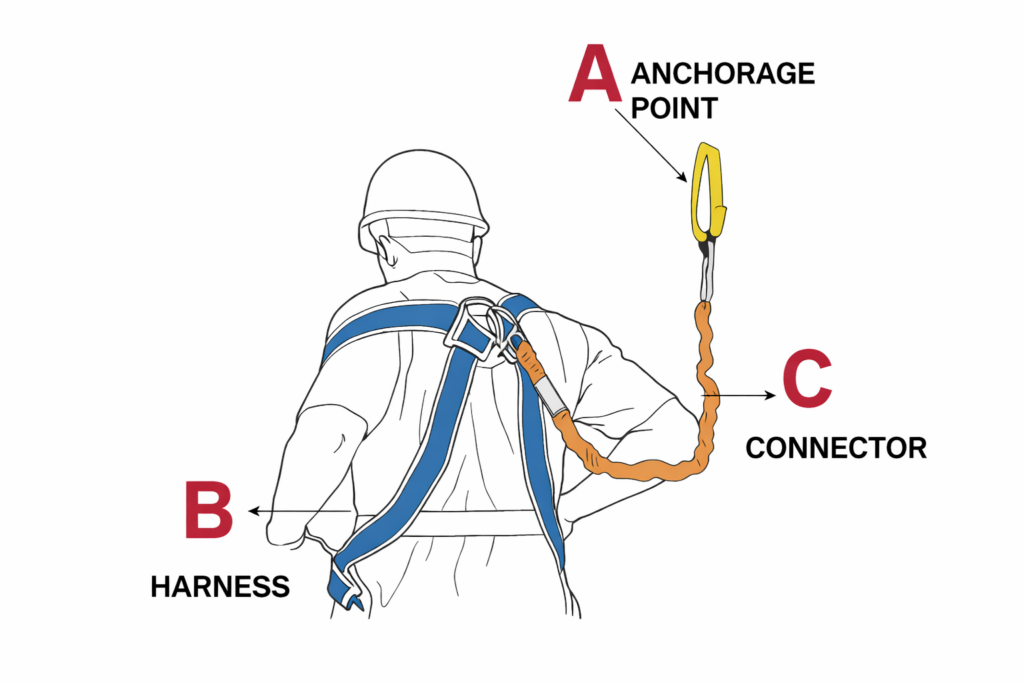
Harness
A series of straps that secure the body and support the user in the event of a fall.
Connector
The element that connects the harness to the anchorage point, such as a shock-absorbing lanyard. Different types of connectors may be required depending on the task.
Anchorage Point
A structural point capable of supporting at least 5,000 pounds (2,267 kg) where the system is connected.
Now imagine you have your harness and a proper anchorage point, but you have no way to connect to it because you are missing the lanyard with shock absorber, which in this case is your connector. Since one part of the system is missing, you would not be protected in the event of a fall.
From a technical perspective, if one element of the system is absent, the system cannot function correctly, and therefore you are not protected.
For this reason, it is essential to always think in terms of fall protection systems, not just individual pieces of equipment, when performing high-risk tasks. The advantage of a personal fall protection system is that, unlike a computer with many components, it consists of only three basic elements, which are easy to remember.
This article may have gone a bit further than expected, but these concepts are important and highly useful when developing a fall protection plan.
Work safely, and until next time.
Author: Gianfranco Binda
Bison Up – High Access Specialist