
Would you know how to identify the type of ladder you need for the job — and how to use it safely?
Greetings once again, my friend. In this opportunity, I want to share with you a brief safety article about portable ladders and how to work safely on them. I hope you enjoy it.
Many times, when we need to perform work at height—such as installing or maintaining light fixtures, inspections, painting, electrical installations, adjusting or installing machinery or equipment, and similar tasks—our job or environment requires us to reach the work point in a way that is simple, fast, and above all, safe.
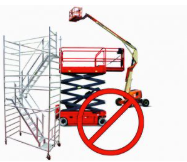
However, in many cases, it is not possible to use scaffolding, aerial lifts, or any other self-supported access structure due to conditions that simply do not allow it.
For example: limited space in the work area, rooms or halls with standard door sizes that prevent moving scaffolds or machinery inside, proximity to roads or highways where equipment would block traffic, or even the need to perform the work quickly.

As a result, we often choose to use portable access ladders to perform the task. At first glance, ladders may seem to have no mystery behind them and appear to be simple in both function and use.
But that is not entirely true.

Although portable ladders may look simple and straightforward when it comes to selecting and using them, there is much more behind them than most people imagine. In fact, there are entire standards, protocols, and regulations—many pages long—dedicated exclusively to ladders.
Let’s start with a few key questions to frame this article:
- What types of ladders are available on the market?
- What are their differences, classes, and categories?
- What is their load capacity and reach?
- What materials are they made of?
- How many people are involved in their proper use?
- How should workers protect themselves while using them?
(Among other questions that may arise.)
NOTE: This article covers only the essential knowledge a user must have for the safe use of portable ladders. Regulations, laws, and protocols related to ladders are far more extensive than what is presented here, as they also address materials, configuration, manufacturing processes, strength testing, and more. As with any equipment used for high-risk tasks, ladders must comply with applicable standards and be properly certified.
The purpose of this article is to explain the different types of ladders available, their functions, and how they should be used, so you can choose the best option based on your needs and the task to be performed.

Before starting any job or selecting equipment, the work environment must always be analyzed by conducting a Job Safety Analysis (JSA) or a similar assessment. In the case of ladders, the first factor to evaluate before deciding on the ladder’s type and size is whether there is any possibility of electrical exposure in the work area, since this will determine the material from which the ladder must be made.
In this article, you will find different ladder types depending on the task at hand. However, regardless of the ladder type required, all ladders are typically available in two primary material options.
In the market, ladders are primarily manufactured from two main materials:
- Aluminum
- Fiberglass or similar non-conductive materials
NOTE: Wooden ladders are not considered here because, in many industrial settings, they are no longer permitted. Some countries still allow them, so always verify local regulations when necessary.
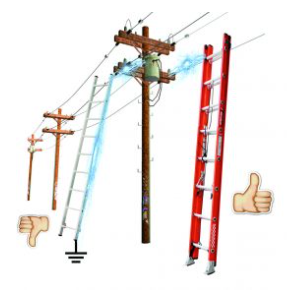
Aluminum ladders, due to the material’s high electrical conductivity, are limited to general tasks where no electrical hazard is present.
Fiberglass ladders, on the other hand, are specifically designed to protect users from potential electrical contact. They reduce the risk of electric shock in situations where the ladder may accidentally come into contact with energized components such as wiring, panels, motors, transformers, or electrical lines.
The purpose of using a non-conductive material is simple: electricity will always seek a path to ground. If the ladder can serve as that path, it will—and if you are on it, you become part of the circuit.
Let’s continue.
At this point, the material of the ladder has been defined. However, additional factors must be considered before selecting the appropriate ladder for the task.
One key aspect is the number of workers involved. This directly determines how many ladders are required.

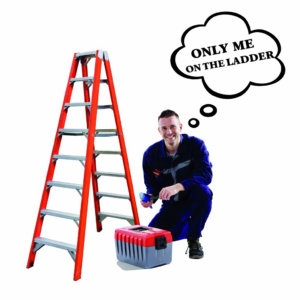
As a rule, one ladder is used by one worker only. It is prohibited for more than one person to be on the same portable ladder at the same time.
NOTE: This rule applies to anyone positioned on any part of the ladder. A second person may stabilize the ladder from the ground to prevent slipping or movement while the worker climbs, but this person must remain with both feet on the ground, never on the ladder. Even though anti-slip feet are mandatory, there is always a possibility of movement or sliding.
Another important aspect to consider is the role the ladder will play in the task, since it can be used in two different ways:
Ladder used as access to an elevated work area
For example, when work must be performed on the exterior of a roof, where the ladder is used only to climb up or down and is no longer used once the worker is positioned on the roof.

When used this way, single-section straight ladders or extension ladders are typically the best option. However, there are specific considerations that must be respected in their use, which will be explained later in this article.
Ladder used as a working surface
In this case, the ladder becomes the worker’s positioning method, meaning the task is performed while standing on it—for example, working on top of a pole, replacing indoor lighting fixtures, installing awnings, or similar activities where the job is carried out entirely from the ladder.

When the ladder is used for this purpose (as a working platform), straight or extension ladders can still be used—especially on poles—but the ideal option is typically an A-frame stepladder with four legs, since it is more stable and semi self-supporting. As with straight or extension ladders, specific usage considerations will be addressed later in this article.
Note: If a straight or extension ladder must be used as a working platform, it should, whenever possible, be secured or tied off to the structure being worked on to prevent lateral movement and loss of stability. Additionally, fall protection equipment must be considered whenever the height meets the threshold defined for work at height.
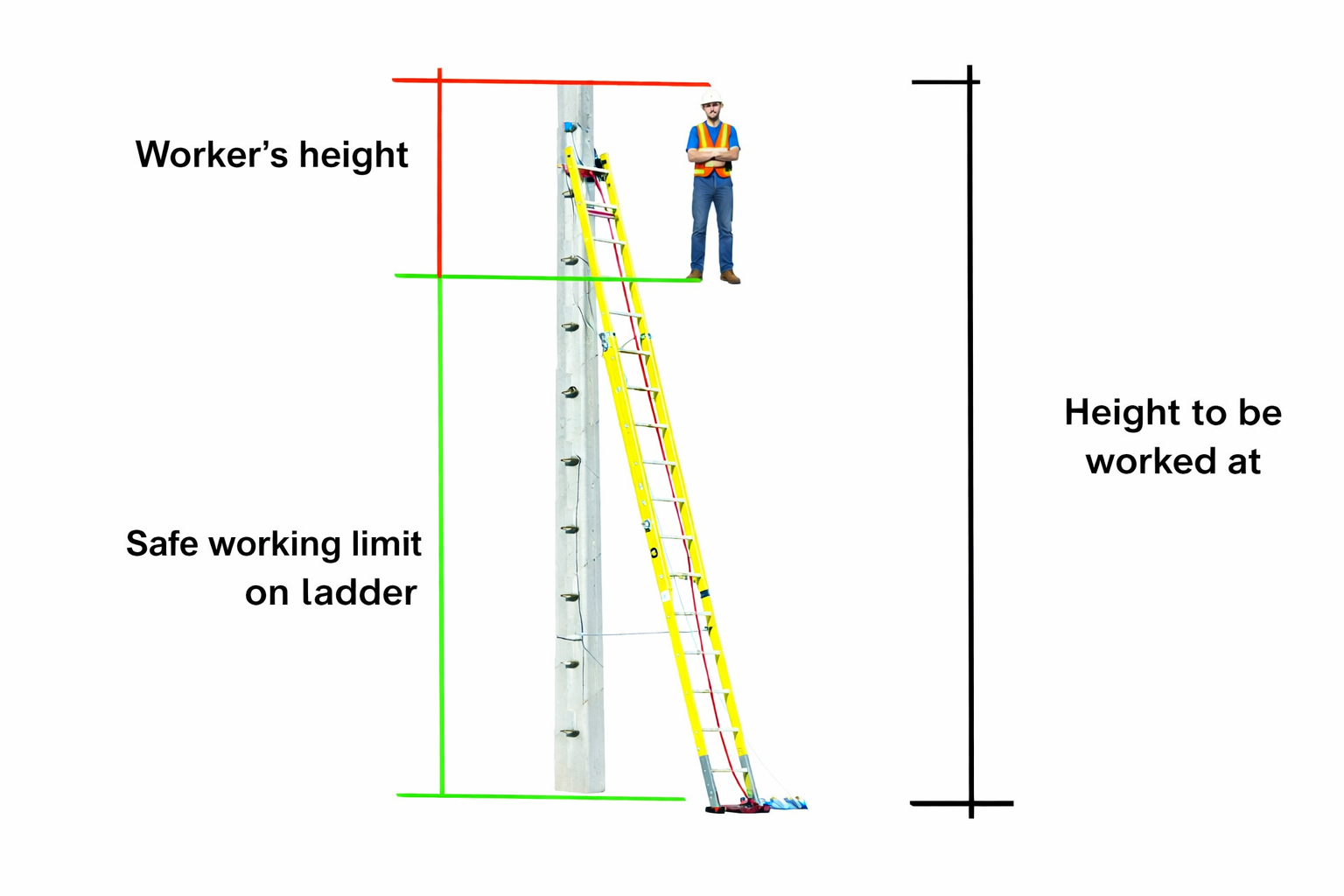
Once the previous points have been considered, it is also necessary to determine the exact working height (not an estimate). This will help define the proper ladder length and the number of rungs required to reach the work area safely and comfortably.
When selecting the ladder size, remember that the top rung must never be used as a standing surface. As a general rule, at least three rungs should always remain unused at the top. The ladder height must be selected with this limitation in mind.
With this clear, it is now possible to choose the ladder model that best fits the job requirements.
The following are the most common ladder types available on the market and can be selected according to the specific needs of the task:
Most Common Ladder Types
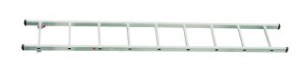
Single-section straight ladders
These ladders can reach lengths of up to 30 ft. They are easy to transport and position.
Extension ladders
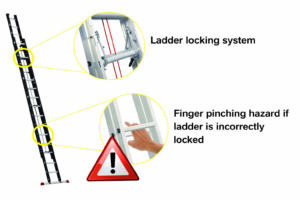
Made of two or more sections connected by side rails, these ladders can extend up to 32 ft. Proper setup is critical. They include ropes, pulleys, and locking mechanisms that must be used correctly. Improper handling can cause serious injuries, including finger entrapment if the ladder closes unexpectedly.
Single-access step ladders (A-frame)
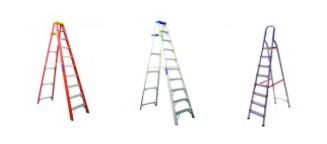
These ladders have four legs and rungs on only one side. They are stable and commonly used as a working platform.
Double-access step ladders (A-frame)
Also built with four legs, but with rungs on both sides. This design allows access from either side, not simultaneous use by two workers. Only one person is allowed on the ladder at any time.
Sectional (stackable) ladders
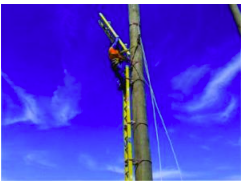
Composed of shorter straight sections that are assembled vertically to reach greater heights. Commonly used for climbing poles. Their use requires trained personnel, as proper assembly, tying, and tensioning techniques (including specialized knots) are necessary to ensure stability and safety.
Podium / scaffold-type ladders
Built with a right-triangle configuration, these ladders include a working platform, guardrails (minimum 42 in height with top rail, mid-rail, and toe board), and locking wheels for mobility. Often referred to as “aircraft ladders” due to their resemblance to those used for boarding airplanes, but in a smaller format.

Now that the most common ladder models and their functions are clear, the total load the ladder will support must also be considered. This includes:
- Worker’s body weight
- Tools and equipment being carried
- Materials required for the task
This combined load determines the duty rating the ladder must meet.
OSHA classifies ladders into different types based on their load capacity.
Note: OSHA is used here as a reference standard. Always verify the regulations applicable in your country or jurisdiction.
Ladders are categorized as follows according to their duty rating:
TYPE IAA
These ladders support the highest workload, with a duty rating of up to 375 lb (170 kg). They are used for professional industrial work where the job demands and frequency of use are heavy and rigorous.
TYPE IA
These ladders support a workload of up to 300 lb (136 kg). They are used for simpler but frequent industrial tasks.
TYPE I
These ladders support a workload of up to 250 lb (113 kg).
TYPE II
These ladders support a workload of up to 225 lb (102 kg). Ideal for commercial environments where access to areas out of reach is required.
TYPE III
These ladders are commonly used for household tasks, with a workload capacity of up to 200 lb (91 kg). They are ideal for simple, infrequent tasks where high resistance is not required, such as reaching items in cabinets, changing light bulbs, hanging pictures, cleaning, or organizing storage spaces. They are generally step-ladder models.

In industrial settings, since tools and heavy materials are often involved, it is recommended to use ladders with the highest possible duty rating, such as Type IAA, IA, or Type I. It is also necessary to determine the height that must be reached and whether a straight or extension ladder is more appropriate (when it must be leaned against a structure), or a step ladder (which allows access to the work area without leaning against a wall, pole, or structure).
As you may have noticed, selecting the ladder that best fits your needs is not something to take lightly. We have discussed materials, shapes, types, and load capacities, but there is still something very important missing: safe use considerations. Having the best ladder is useless if it is not used correctly.
In this part of the article, we will review some important considerations to keep in mind before working with ladders.
Considerations for the Use of Ladders
Regarding single-section or extension ladders, since they are not self-supporting like step ladders, they must be positioned at a diagonal angle following a 4:1 ratio. This means that for every 4 ft (1.2 m) of ladder height, the base must be 1 ft (30 cm) away from the structure it is leaning against.
This ratio helps maintain an approximate 75° angle, which provides proper ladder stability.

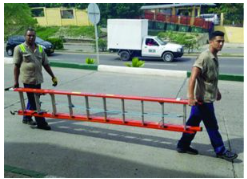
As mentioned earlier, taller ladders can reach considerable lengths, so for handling, transporting, and especially positioning them, it is always recommended to use two people.
Regarding step ladders, although they stand on four legs and are more stable, this does not mean they are safer if used improperly.
Both straight/extension ladders and step ladders must be placed on level, flat surfaces, without side tilting. Never attempt to level a ladder by placing it on wooden blocks, bricks, tiles, or other unstable objects. Ladders must be stable on their own when placed on a proper surface.

When using straight or extension ladders to access an elevated surface, they must extend at least 3 ft (1 m) above the surface being accessed. This provides a secure handhold when transitioning from the ladder to the structure and back, without having to “climb over” the edge.

Always mark off the lower work area with high-visibility tape, cones, or mesh barriers to prevent pedestrians from walking underneath the ladder. It is recommended to maintain a clear perimeter of 6 ft (1.8 m). This also allows operators of equipment such as vehicles, forklifts, pallet jacks, and lift trucks to clearly identify the work zone and avoid passing near the ladder.
When climbing a ladder, always maintain three points of contact (two hands and one foot, or two feet and one hand, alternating movement while climbing).
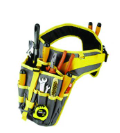
Hands must never be occupied while climbing. Tool belts, rope systems, or pulley systems should be used to raise materials and equipment to the work area. Ladders are NOT meant for carrying loads while climbing.
These are some of the most important aspects to remember regarding the selection and use of portable ladders. This is not everything, but it covers the essentials.
Never underestimate a task just because it appears simple. It is important to recognize the hazards and risks involved in using a ladder. In this case, the height reached is the main hazard, and the ladder fall is the potential risk.
NOTE: The difference between hazards and risks is explained in another article available in our virtual library, referenced here:

To close, remember this: where there are no hazards, there are no risks. But the moment we introduce any element to perform a task—such as our very useful, simple, and “safe” ladder—we immediately create hazards and risks where none previously existed.
In short, ladders are tools that we ourselves use to create hazards, which is why their use must always be approached with caution and proper analysis.
Do not forget: one of the leading causes of serious and fatal fall accidents comes from falls off portable ladders.
With that said, I’ll leave you here, thanking you for the time invested in reading this article, and hoping it has been useful.
Have a safe day.
Until next time!
Author: Gianfranco Binda
Bison Up – High Access Specialist