Do you know the difference between standards, certifications, and equipment approvals when it comes to protective gear?
Welcome back. I’m here to add—if possible—one more topic to your safety knowledge, helping close those small gaps that can remain even when someone is highly specialized in a particular area.
If, after reading this article, you gain a clearer understanding of these concepts, I’ll be satisfied knowing it added value. And if you were already familiar with the topic, I truly appreciate the time you took to read it.
Let’s begin with the topic of this article.
This time, I want to address a subject that often creates confusion, leading people to incorrectly interpret terms such as standards, certifications, and equipment approvals when it comes to protective equipment.

We’ve all experienced this: before starting a job that requires the use of protective equipment, the safety department of the company we’re about to work for requires that workers use equipment that meets specific quality and safety standards as part of their safety protocols.
This is where confusion usually begins. We’re often told that the equipment must be compliant with standards, other times that it must be certified, and in some cases that it must be approved. In some companies, they even ask for all three at the same time, leaving us even more confused about what they actually mean.
The purpose of this article is to clearly explain the difference between these terms—because they do not mean the same thing—so you understand how important each one is and the role they play in ensuring that the equipment you use for your protection is manufactured under proper quality and safety standards.

As you may have noticed, this article is not about a specific high-risk task. Instead, we will focus on the essential characteristics that any protective equipment must have to ensure it has been manufactured under recognized safety and quality standards.
As mentioned earlier, when defining the requirements for protective equipment, these terms frequently come up, and although they may seem similar, they are not.
These terms are:
Standards (you’re told: the equipment must comply with a standard)
Certifications (you’re told: the equipment must be certified)
Equipment approvals (you’re told: the equipment must be approved)
NOTE: This article focuses specifically on protective equipment. Standards, certifications, and approvals exist for many other fields as well, where their application may differ from how they apply to protective equipment.
Let’s start by explaining each one.
Standards
This is probably the most commonly used term—and often the most misused. Many people apply it to everything, frequently saying that something must be done “because the standard says so,” even when the standard has nothing to do with the issue at hand. But since we’re talking specifically about equipment here, let’s focus on what it really means for protective equipment to comply with a standard.

Let’s start by understanding what a manufacturer must do for their equipment to comply with a standard. As an example, I’ll use ANSI—not because it is better than others, but because it is widely used in my country. Any standard developed through a serious process of research, evaluation, and technical review can be considered reliable. Later, I’ll mention which standards are regarded as the most recognized due to the rigor of their development and evaluation processes.
NOTE: The development and review of a standard must involve qualified professionals with the knowledge required to evaluate the characteristics that protective equipment must have. After all, someone’s life may depend on it.
To explain this, imagine you are a manufacturer of protective equipment and want to expand your product line by producing industrial safety helmets. For your helmets to be accepted in the market, they must comply with the ANSI standard.
To keep things simple and avoid getting overly technical, think of ANSI (or any standard) as an instruction manual that tells you exactly how equipment must be designed, manufactured, and tested to be considered safe.
Keeping ANSI as our reference example, let’s see how a standard like ANSI is developed for protective equipment.
To explain this, let’s continue with the helmet example.
Imagine that ANSI decides to develop a standard for a helmet capable of withstanding a 50-ton impact (you’ll understand this is an exaggerated example, since 50 tons is unrealistic for an impact—regardless of whether the helmet resists it, the person wearing it would still be crushed).
Continuing with this hypothetical 50-ton helmet, ANSI would need to create a standard that ensures the helmet is manufactured under specific quality and safety requirements so it can meet that performance characteristic. To do this, the professionals involved in developing the ANSI standard would research aspects such as the type of plastic to be used, the required thickness, the shape, the material and design of the internal harness, the type of impact tests to be performed, and the specific testing equipment required to verify its resistance. In other words, ANSI studies everything—from how and with what materials the helmet must be manufactured to how it must be tested to confirm its performance.
All of this information—materials, configuration, manufacturing process, required impact tests, and more—is written into a formal document.
As a manufacturer, you obtain this document and use it as the reference to produce your helmets. If you manufacture and test your helmet exactly as described in the ANSI document for 50-ton helmets, then your helmet complies with that ANSI standard.

It’s also important to understand that standards define the minimum characteristics equipment must have to fulfill its intended purpose. This means that as a manufacturer, you can exceed the requirements of the standard and still remain compliant. For example, you might add a flashlight mount, a more comfortable chin strap, or even design the helmet to withstand more than what the standard requires. That does not mean your helmet “complies more” with the standard.
NOTE: No piece of equipment complies with a standard more than another. There are only two possibilities: it complies, or it does not.
Main standards, but not necessarily the best.

The previous title may seem a bit contradictory, but it isn’t. A standard is considered “main” not because it is better than others, but because the organization that develops it is widely recognized for the seriousness of its research, evaluation, and review processes—and because its name and origin are well known.
For example, let’s imagine a country called “New Country” that does not have its own standard and decides to create one. To do this, it copies the ANSI standard word for word, making it identical to ANSI.
In that case, the standard from this fictional country would not be better or worse than ANSI, since both say exactly the same thing.

Now imagine someone from that country goes abroad to work, bringing equipment that complies with the “New Country” standard. Because that standard is unfamiliar, a safety manager may not allow its use simply because they do not recognize it—or may not even know that such a country exists.
On the other hand, if the equipment complies with ANSI, that same safety manager is far more likely to recognize it, since it comes from one of the most well-known standards in the world (the United States).
This is why many pieces of equipment comply with widely recognized standards such as ANSI even when they are not manufactured by U.S. brands. Manufacturers do this to ensure their products will be accepted anywhere.
NOTE: These standards are considered “main” because they are widely recognized, not because they are inherently better. Any standard, regardless of origin, that is current and aligned with recognized safety practices can be just as reliable.
Manufacturers, regardless of their country of origin, often design their products to comply with these widely recognized standards in addition to their own national standards. Many even ensure compliance with several—or all—of the major standards to guarantee their products can be accepted, sold, and used worldwide.
The most recognized and widely referenced standards are:
ANSI = United States, EN = Europe, CSA = Canada, AS/NZS = Australia and New Zealand
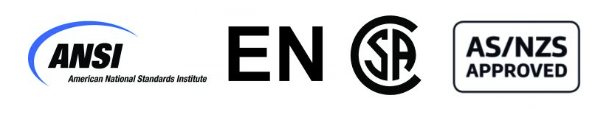
NOTE: In this article, I am referring specifically to the main standards related to the manufacturing of protective equipment. There are other widely used references—such as OSHA, NFPA, ISO, and others—but these do not directly address the manufacturing of protective equipment. For that reason, they are not covered here in detail and will be discussed in a future article.
Although this article focuses on the primary standards used in the manufacturing of protective equipment, in the next section I will reference OSHA in one of the examples. OSHA is the authority responsible for occupational health and safety in the United States, and the concept I’m about to explain applies to standards in general, not only to protective equipment.
Hierarchy for selecting standards when no local standard exists
At this point, I’m going to step slightly outside the main topic, because it’s important to understand that there is a hierarchy to follow when selecting a standard in cases where a country, organization, or company does not have its own internal standard and must adopt an external one to remain aligned with current safety practices.
Here’s how this hierarchy works:
If a country, organization, or company does not have its own internal standard, the first category to consider should be globally recognized standards. If no global standard fits their needs, the second option should be multinational standards, such as EN, which applies across multiple countries within the European community.
If no suitable standard is found at that level, the third option should be national standards—those issued by a single country—such as OSHA. And if none of these national standards apply to their situation, the final alternative is to rely on standards developed by private organizations or professional associations, such as ANSI.

NOTE: In this section, I’m referring to standards in general, not only those related to protective equipment. I apologize for briefly stepping outside the main topic.
Let’s return to protective equipment.
Going back to the helmet example designed to withstand a 100,000 lb impact (45,360 kg), at this point, as a manufacturer, you have obtained the ANSI standard and produced your helmets exactly as the standard specifies. In theory, your helmets comply with that standard.
The question you might ask as a manufacturer is: if your helmets already comply with the ANSI standard, can you start selling them?
The answer is no.
This is not about questioning anyone’s honesty or integrity. The real issue is this: how can the end user be sure that you actually manufactured and tested your helmets exactly as required by the ANSI standard?
To demonstrate that you truly followed the standard in both manufacturing and testing, your helmets must be certified.
Certifications